The Dying Sea Aral
“The Aral Sea region is heavily polluted, with consequent serious public health problems, so that UNESCO has added historical documents concerning the Aral Sea to its “Memory of the World Register” as a resource to study the environmental tragedy.”
This is the story about one of the most severe ecological disasters on Earth... and hope.
“Clearly one of the worst environmental disasters of the world” the words of UN Secretary-General Ban Ki-moon.
On the border of Kazakhstan and Uzbekistan lies the Aral Sea, once the world’s fourth largest freshwater lake. For thousands of years the sea has been a life giver, bringing food, trade and civilization. During the times of Soviet Union, the Aral Sea alone provided 1/6 of all fish in the country and employed more than 40.000 people. Having roughly the same size as Ireland and unique ecosystem, the lake was the centre of vital local economies. If you were watching the fishermen working in full swing, children swimming and tourists coming from different places to try the Aral’s famous caviar, you would think it lasts forever. Sadly, it wasn’t the case.
Now it is a giant desert bed full of rusting ships and broken dreams. What happened?
There are two rivers that used to feed the Aral Sea: the Amu Darya in the south and Syr Darya in the east. The Soviet Union’s leader, Stalin believed that nature itself could benefit his country and planned to make cotton a major Soviet export at any cost. His engineers diverted the water from both of the rivers by digging canals towards new fields and they began growing a “white gold”. For a time it kind of worked, and by the late 1980’s Uzbekistan became the world’s largest producer of cotton. However, an irrigation project went wrong, depriving the sea of vital water. That network of irrigation channels was not just taking huge amount of water from the Aral, but it was also insanely inefficient and leaked constantly. As a result, the fourth largest lake in the world began steadily drying up. By 1987, the drying was so bad that there was no longer a single Aral Sea, instead, the waters split in two, creating a smaller North Aral Sea in Kazakhstan, and a larger South Aral Sea lying mostly in Uzbekistan. By 1998, it had shrunk to just 60%, and by 2004 it was down to only 25% of its original size. In addition to this, the other half of the disaster was the rapidly rising level of salinity. Down to only 10% of what it once was made the remained lake five times saltier than it was back in the 1960’s. The increased salinity caused the collapse of its entire ecosystem and the creatures that once lived in and around it. So, the new-born gigantic salt desert became worthless for things like agriculture.
But this is not the end of the story. Besides all said above, the lake was often used as a dumping ground for toxic chemicals and weapons for decades too. Soviet water scientists had predicted it would bake into a hard crust, it instead remained loose, at the whims of the largest breeze the air around the Aral Sea became toxic to breathe. The Aral Sea region is heavily polluted, with consequent serious public health problems, so that UNESCO has added historical documents concerning the Aral Sea to its “Memory of the World Register” as a resource to study the environmental tragedy.
Life around the former Aral Sea today is a harsh one. Infant mortality is very high, at 75 deaths per 1.000 births. If the Aral region were its own country, that would be the fifth worst rate in the world. So far, the legacy of poor engineering decisions still looms high over the lives of locals here. Large bodies of water help regulate the weather conditions and since the water has vanished, the temperatures nowadays swing from -40C in winters to +40 during summers. Today, the Aral region is so deadly that it’s been often called the Silent Chernobyl. Same as Chernobyl, it was an environmental catastrophe made of Soviet incompetence and similarly it left behind ghost towns near the salty toxic desert.
And as I said this is also a story of hope, while the unfolding disaster has continued in the South Aral Sea, the same cannot be said for its northern part lying in Kazakhstan. In early 2000’s Kazakhstan’s government decided that, rather than let both seas die, they’d sacrifice one to save the other. To everyone’s surprise they managed to save the North Aral Sea by completely severing it from the South and building a vast dike as the Kokaral dam. In just half a year the water level increased for 4 meters, the waters got closer and closer to the old fishing villages and the salinity began to drop. A few years later the government of Kazakhstan successfully reintroduced fish that were originally inhabiting the area and now can witness them thriving again.
Surely, the recovery of the North Aral Sea hasn’t been easy and it’s still a long way from where it once was. But with the returning water back to the shores the glimpse of hope is returning to our hearts.
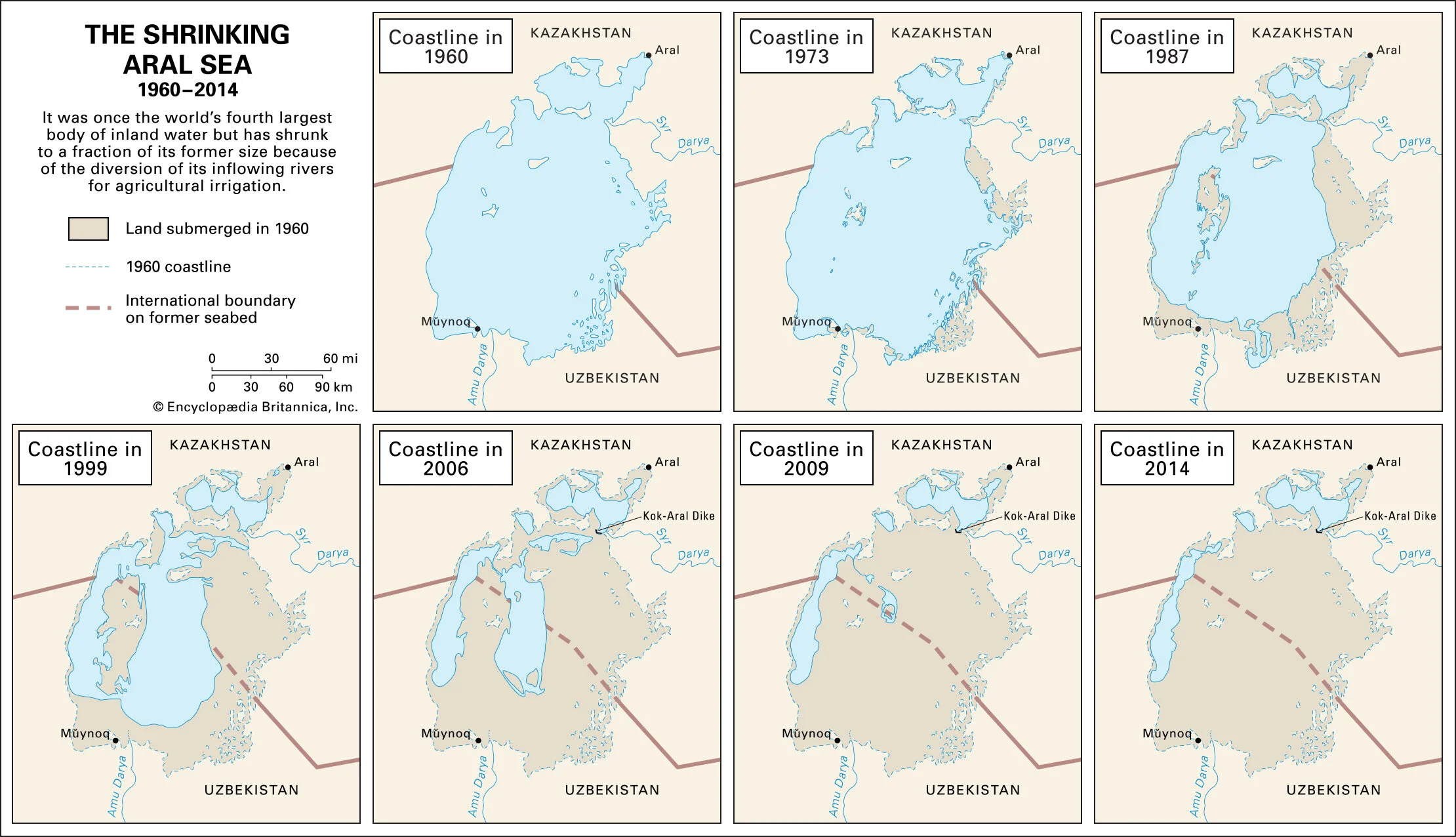
Shrinkage of the Aral Sea, 1960–2009. Adapted from Philip Micklin, Western Michigan University
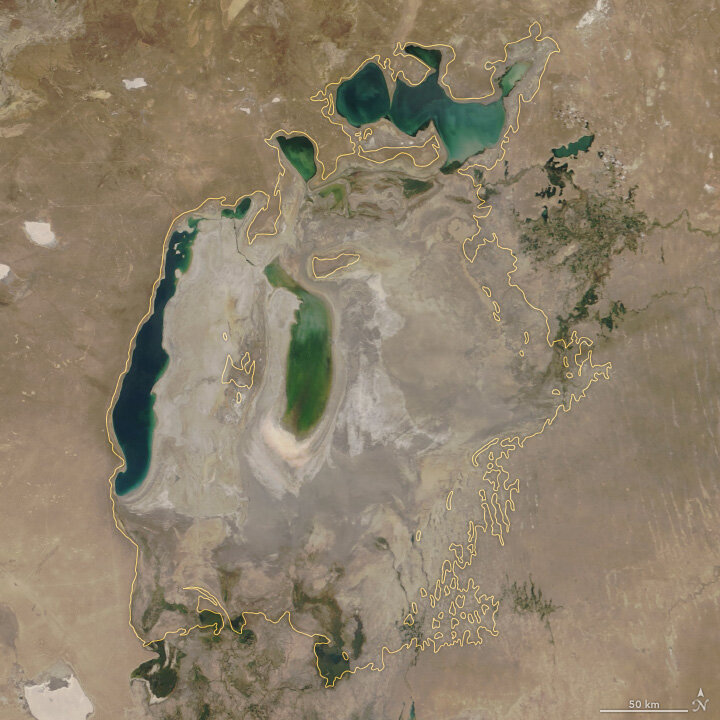
Satellite image of Aral Sea taken by NASA (contour line is the shoreline in 1960s)

Stranded ships at the dried-up port of Moynaq in the Aral Sea © imageBROKER/Shutterstock
https://www.lonelyplanet.com/articles/uzbekistans-stihia-festival
References:
https://www.bbc.co.uk/programmes/p02k871g
https://www.bbc.com/future/article/20180719-how-kazakhstan-brought-the-aral-sea-back-to-life
https://www.britannica.com/place/Aral-Sea
https://en.wikipedia.org/wiki/Aral_Sea
https://www.nationalgeographic.com/magazine/2015/06/vanishing-aral-sea-kazakhstan-uzbekistan/